How Does Amazon Stock Continue to Rise
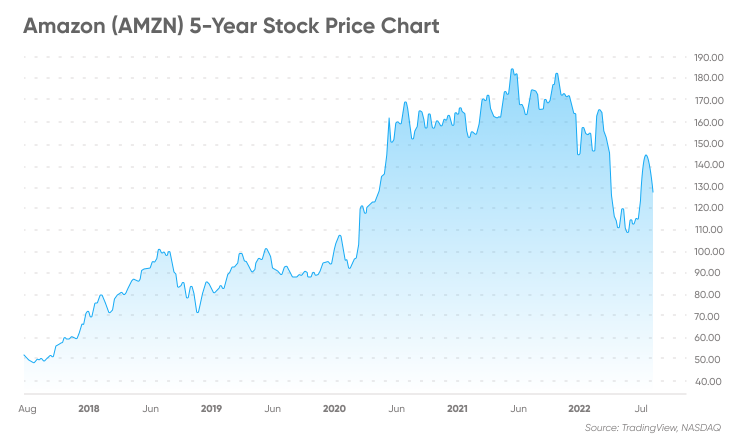
The Amazon (AMZN) stock price has had a rebound in the past three months after what has been a difficult 2022 so far.
AMZN stock is up over 7% from June to early September, although the company's shares have shed more than 20% of their value year-to-date (YTD).
Will the uptrend for the share price continue over the remainder of the year? Read on for our analysis of the latest news, price action and fundamentals, to outline a plausible Amazon stock forecast.
Amazon company history
The company was founded in 1994 by entrepreneur Jeff Bezos who recognised the e-commerce potential of the fast-growing internet.
Amazon was originally an online bookselling platform, as being able to list all titles online gave the company an advantage over in-person booksellers who had to print long and expensive paper catalogues. In its early years, Amazon famously operated out of Bezos' garage in Bellevue, Washington.
The company officially debuted in October 1995, and in two months was earning $20,000 a week in sales.
On 15 May 1997, the company went public at $18 a share, listing on the NASDAQ.
However, it would be several years before Amazon would be able to turn a profit. This was something the company had anticipated: in its 1997 Securities and Exchange Commission (SEC) listing, Amazon stated that, as it had "relatively low product gross margins, achieving profitability given planned investment levels depends upon the company's ability to generate and sustain substantially increased revenue levels.
"As a result, the company believes that it will continue to incur substantial operating losses for the foreseeable future." it added.
In 2001, the bursting of the dot com bubble saw the destruction of many e-commerce companies. However, Amazon survived and in the fourth quarter of that year it would turn its first profit, earning $5m.
The company would continue innovating over the following years, launching products and services, including two-day membership delivery Amazon Prime in 2005, Fulfillment by Amazon in 2006, electronic reading device Amazon Kindle in 2007, and electronic voice assistant Echo & Alexa in 2016.
Amazon also branched out into music and film with Amazon Music and Amazon Instant Video.
Amazon stock analysis: Will it survive stagflation headwind?
On 13 July, the US annualised inflation reading for June came in at 9.1% – the largest 12-month increase since the period ending November 1981.
Changes in the country's Consumer Price Index (CPI) may prompt the Federal Reserve (Fed) to hike interest rates faster and to a greater extent.
For equities – a sector highly favoured during the pandemic – this scenario is particularly disadvantageous, as risk premiums could increase. The chance that the US may enter a period of recession also weighed on market forecasts.
"Recession risks are high – uncomfortably high – and rising," Mark Zandi, chief economist at Moody's Analytics, said in a note in mid-June. "For the economy to navigate through without suffering a downturn, we need some very deft policymaking from the Fed and a bit of luck."
The 20-for-1 stock split approved by Amazon's board of directors, which was completed on 3 June, did little to prevent prices from falling throughout the month.
Amazon stock news and price drivers
As of 2 September, Amazon stock has slid 26.19% YTD. Negative sentiment toward equities that started back in November 2021 continued into the first semester of 2022, driving the company's stock price down.
A combination of negative macro factors, rising geopolitical tensions in Europe and still relatively complicated supply-chain dynamics are affecting the company's prospects.
"The war in Ukraine, lockdowns in China, supply-chain disruptions and the risk of stagflation are hammering growth. For many countries, recession will be hard to avoid," said World Bank president David Malpass.
In late April, Amazon's stock fell 14% on the day the company released its financial results covering the first quarter of the 2022 fiscal year. Back then, the company reported a $3.8bn net loss due to a $7.6bn markdown of its investment in Rivian (RIVN) – the electric vehicle startup in which the company has a large stake.
On 3 June, David H Clark, Amazon's CEO for Worldwide Consumer, resigned from the company. The timing of Clark's departure means changes in the leadership team at a point when operational conditions for the business are complex.
Referring to Clark's departure, Amazon CEO Andy Jassy said: "The past few years have been among the most challenging and unpredictable we've faced in the history of Amazon's Consumer business, and I'm particularly appreciative of Dave's leadership during that time."
Amazon also announced the closure of its Amazon Care project in late August – a plan to provide a health platform to patients. In a memo sent out to employees, Amazon health services head Neil Lindsay said that "[Amazon Care] is not a complete enough offering for the large enterprise customers we have been targeting".
However, the setback is unlikely to deter the company's plans to expand into the healthcare industry. In late July, Amazon acquired established telehealth service firm One Medical for $3.9bn – its biggest deal in the healthcare sector so far – which may help it fill the shortcomings of Amazon Care.
One Medical is a "human-centered and technology-powered primary care organisation with seamless digital health and inviting in-office care, convenient to where people work, shop, live and click", as stated in the announcement.
Following the drop witnessed in the first half of the year, which saw the company shed close to $75 of its stock price, AMZN is trading around the $130 mark after showing almost 5% growth in the past three months.
Amazon latest earnings
Amazon reported its financial results covering the second quarter of the 2022 fiscal year on 28 July.
Consolidated net sales during the quarter ended at $121.23bn, resulting in a 7% year-on-year (YOY) jump. Notably, the AWS segment experienced a 7% YOY increase with revenues landing at $19.7bn.
Sales growth in North America for the retail segment was also positive at 10% compared to a year ago. However, international retail sales experienced a 11% drop to $27.06bn.
Amazon's operating income decreased to $627m from $3.14bn a year ago.
By the end of this quarter, Amazon's long-term debt stood at $66.52bn on total assets of $419.72bn, including $37.47bn in cash and equivalents. Amazon currently does not pay a dividend.
Amazon stock predictions: Analyst sentiment
Commenting on the company's prospects and Amazon share price forecast in mid-June, David Jones, chief market strategist at Capital.com, highlighted that a broader pressure on the technology sector remains intact:
"Amazon stock is down by a third for the year so far and in May traded to its worst levels in more than two years. Given that the broader technology sector remains under pressure and investors are still not sure where the bottom is, it would not be surprising if there were further slides in the Amazon stock price.
"For the more aggressive short-term trader, one level to watch is $100. This has so far proved to be a short-term bottom in May and could be something of a psychological zone where some are happy to step in and try to pick a bottom. That is one thing to watch over the next few days as a 'trading buy' – but medium term, it would probably be a better choice for investors to remain patient and wait for the wider market sell-off to show signs of stopping."
According to data compiled by TipRanks as of 2 September, the consensus analyst forecast for Amazon stock was bullish. A total of 38 analysts rated the stock as a buy, while one preferred to hold it.
The consensus AMZN stock forecast for the next 12 months stood at $176.94 a share – a potential 36% upside on the company's stock price of $130 in early September. Meanwhile, the highest Amazon stock forecast was $270 while the lowest stood at $118.
Numerous analysts gave revised ratings of Amazon following the release of its Q2 results. On 29 July – the day after the earnings results announcement – JP Morgan maintained a 'buy' rating on AMZN while revising the price target upwards from $175 to $185.
The same day, Oppenheimer lowered the target price from $165 to $160 while maintaining an outperform rating.
Amazonannounced on 14 Julythat shoppers bought more than 300 million items during this year's edition of Prime Day – up from roughly 250 millionin 2021, making it the biggest Prime Day event in Amazon's history.
In mid-July, Dan Burrows of Kiplinger commented that AMZN stock might be a bargain at current rates:
"If there is a single point of agreement among the many, many AMZN bulls, it's that shares have been beaten down past the point of reason. Here's perhaps the best example of that disconnect: At current levels, Amazon's cloud-computing businessalone is worth more than the value the market is assigning to the entire company. Just look at Amazon's enterprise value, or its theoretical takeout price that accounts for both cash and debt. It stands at $1.09trn. Meanwhile, Amazon Web Services – the company's fast-growing cloud-computing business – has an estimated enterprise value by itself of $1.2trn to $2trn, analysts say."
On 29 July, Analyst Dan Romanoff from Morningstar noted the comeback from retail-related businesses in Q2 2022, saying it painted an encouraging picture for Amazon's Q3 results.
"Amazon reported good second-quarter top-line and bottom-line results which were ahead of FactSet consensus expectations and provided an encouraging revenue outlook for the third quarter. While AWS remains a tremendous opportunity and performed well once again, the more important takeaway this quarter is that retail-related businesses, especially third-party seller services, are coming back and even delivered some upside compared with our expectations. We are not ready to declare victory for the company just yet, but we are encouraged by results and note that the pandemic-fueled growth surge is now removed from prior-year comparisons, so growth should optically improve going forward," Romanoff stated.
On 17 August, following reports that Amazon will impose an incremental 35-cent-per-item fee on Fulfilled By Amazon (FBA) items sold in the US or Canada between mid-October and 14 January, Morgan Stanley analyst Brian Nowak noted that the introduction of the holiday fee came after Amazon raised FBA fees by about 5% earlier in the year. If a seller uses the FBA service, Amazon handles picking, packing and shipping items.
Nowak estimated the fee will lead to about $570M and $90M respectively in Q4 2022 and Q1 2023 EBIT and calls the move a "positive signal" about Amazon's "confidence in the health of its U.S. seller offering and its consumer". Nowak maintained a 'buy' rating on the stock and set a $175 price target on Amazon shares, which indicated a possible 34.79% upside.
A week later, on 24 August, Bernstein analyst Mark Shmulik reiterated a 'buy' rating on the stock with a $160 price target – a potential 23.24% upside on the date of the report. According to Shmulik, things "are looking up" in a challenging macro environment – Amazon remains well-positioned to retake its e-commerce share in the second half of 2022, while initial signs from Prime Day sales are positive. The analyst also said he was "encouraged" by Amazon's progress in clearing up its missteps.
Amazon stock forecast: Targets for 2022 to 2025
What's out there for the Amazon stock forecast 2022 and beyond?Gov.Capital was holding a neutral short-term outlook for Amazon stock based on an analysis of multiple technical indicators. It anticipated the stock to close out the year at $131.526 in December 2022 – close to to the current market price as of 2 September.
The forecaster was far more optimtistic about AMZN's long-term future, predicting it could hit $279.135 by the end of 2023 and $452.874 by the end of 2024.
According to the platform's Amazon stock forecast for 2025, it could end the year at $683.206. Gov.Capital's projection states that AMZN could break the $900 mark in 2026, while the website's five-year prediction suggests AMZN could be trading at $1,110.184 in early September 2027. The service did not provide an Amazon stock forecast for 2030.
These Amazon stock projections have been drafted by algorithms based on analyses of the company's stock price history. There are no guarantees the price of AMZN stock will reach those levels. You should perform your own proper due diligence before investing in Amazon.
Note that algorithm-based predictions can be wrong, and past performance is no guarantee of future returns. Always conduct your own analysis before trading. And never trade money that you cannot afford to lose.
FAQs
Is Amazon a good stock to buy?
Amazon is a company with a robust balance sheet, a highly diversified business model and a capable management team. The valuation of the business is experiencing a decline amid short-term headwinds but its fundamentals remain strong. Whether AMZN stock is a suitable asset depends on your own trading objectives – and the opinion based on your own research. Remember, it's important to reach your own conclusion of the company's prospects and likelihood of achieving analysts' targets. Past performance is no guarantee of success. And never invest money that you cannot afford to lose.
Will Amazon stock go up?
As of 2 September 2022, 38 of 39 analysts surveyed byTipRanks rated AMZN stock a 'buy'. However, these opinions should not be considered a recommendation to invest or trade Amazon stock as many factors not accounted for in these predictions could affect the actual performance of AMZN. Always conduct your own analysis before trading. And never trade money that you cannot afford to lose.
Should I invest in Amazon stock?
The decision to invest in Amazon stock should be made after performing adequate due diligence. Whether Amazon is a good fit for an investor's portfolio or not depends on their financial goals and risk tolerance.
When did Amazon's stock split?
The company's 20-for-1 stock split was completed on 3 June. It had little immediate impact on the share price.
Related reading
Source: https://capital.com/amazon-stock-forecast-is-it-a-buy

Post a Comment for "How Does Amazon Stock Continue to Rise"